
NO 11B, JALAN PUCHONG PERMAI 2, TAMAN PUCHONG PERMAI,
47100, PUCHONG, SELANGOR
+603 5892 6806
Excellent Expertise, Proven Professionals
Liquid or dye penetrant testing (PT) is a non-destructive material testing method which uses capillary forces to find surface cracks or pores and make them visible. It can detect surface-breaking flaws such as cracks, laps, porosity.
MONDIAL's offers a full range of magnetic particle testing products to help you identify surface and subsurface discontinuities in ferromagnetic materials. We offer a wide variety of consumables designed for magnetic particle inspection testing, including fluorescent and visible magnetic particles, carrier liquids, and contrast paints
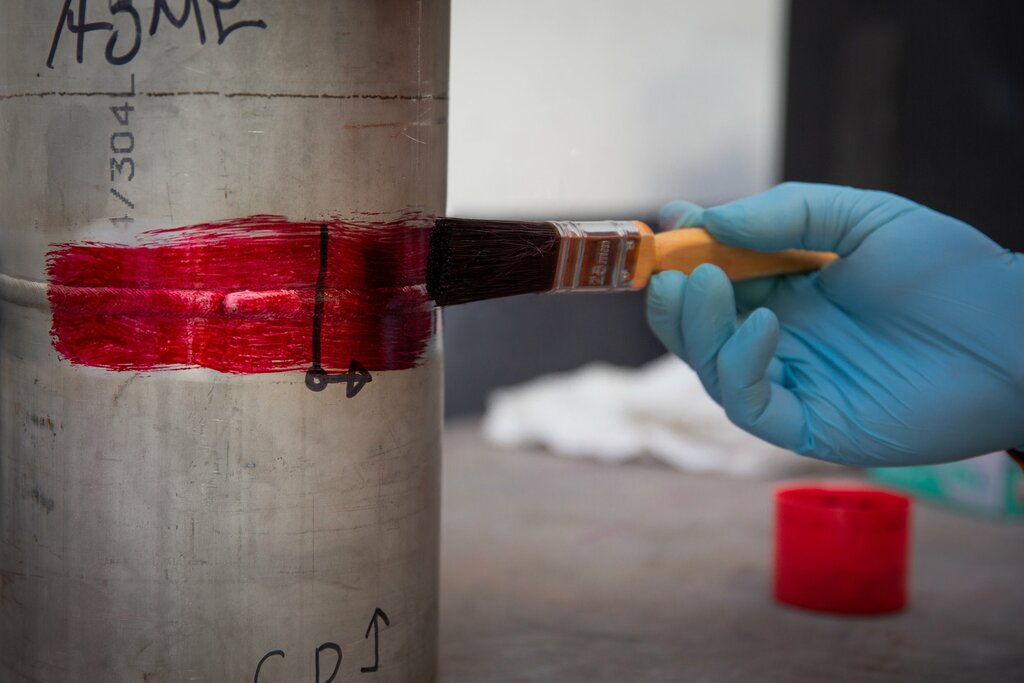
Liquid or dye penetrant testing (PT) is based on the infiltration of liquid penetrant into open surface discontinuities. Penetrant testing is not applicable on high porous materials. The dye penetrant method is used to determine surface defects, including surface cracks, pores, lack of fusion and inter-granular corrosion. Dye penetrant testing is performed on welds and parent material
A distinction should be made between dye penetrant testing and fluorescent penetrant testing, with only the near-surface area of a test piece being examined.
After pre-cleaning, the penetrant is applied to the surface area of the test piece. This penetrates into fine cracks or pores through the capillary effect. After carefully removing the rest of the test medium from the surface, a developer is applied to pull the dye penetrant out of the pores and cracks, creating indications which can then be evaluated.
The Benefits
MONDIAL's has numerous years of experience in providing Liquid Penetrant Testing for all industries using Non-Porous materials, such as metal as their product, ranging from manufacturing, construction, automotive, power generation, petrochemical and oil and gas industries.
The benefits of Liquid Penetrant Testing of Materials
- Global accepted non-destructive testing method
- Easily determine surface cracks, pores, lack of fusion and inter-granular corrosion
- Penetrant testing can be used on a wide range of materials (also non-ferritic and composite)
- Fast and efficient testing method to cover large-area and surfaces
Liquid Penetrant Testing – a six-stage process:
- Surface cleaning (degreasing etc.)
- Application of a penetrant liquid (dipping, spray, brush)
- Removal of excess penetrant (solvent, water)
- Application of developer
- Inspection of test surface (visual, television camera)
- Post-inspection cleaning (anti-corrosion solutions)
Upholds the highest standards of quality assurance for NDT services.
FAQ
Liquid penetrant testing is essentially the process of injecting coloured liquid into a product that will seep into any surface defects. It can detect cracks as narrow as 150 nanometres.
Liquid penetrant testing detects hairline cracks, surface porosity, leaks, and fatigue cracks. It uses liquid dye to see defects that are otherwise not visible to the naked eye.
Liquid penetrant testing can be applied to any non-porous clean material, metallic or non-metallic. It is unsuitable for dirty or rough surfaces.
It is typically a six-step process:
1) Surface cleaning
2) Application of a penetrant liquid
3) Removal of excess penetrant liquid
4) Application of developer
5) Inspection of test surface
6) Post-inspection cleaning